The fitness internet will tell you to train 5 or 6 days a week. This advice is wrong for most beginners — and it’s an easy way to burn out and quit in month two.
Here’s the thing: you don’t need to be in the gym every day to hit everything multiple times per week. Train your whole body on Monday, rest on Tuesday, go again on Wednesday. More frequency, fewer days. It’s a better trade.
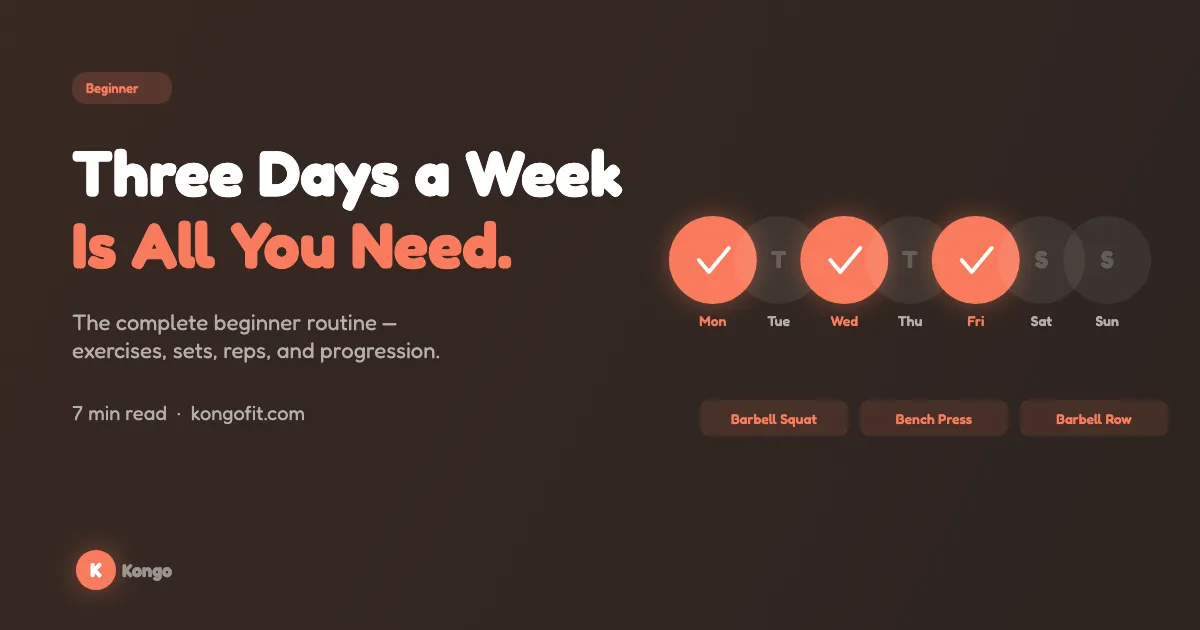
Three days a week — Monday, Wednesday, Friday is the classic, but any three non-consecutive days work — is a solid structure for the first 3–6 months. It sits right inside the American College of Sports Medicine’s recommendation of two to three days a week for beginners.
The routine
Two workouts, alternated each session. Week one: A, B, A. Week two: B, A, B. And so on.
Day A
| Exercise | Sets | Reps | Rest |
|---|---|---|---|
| Barbell Squat | 3 | 5 | 3 min |
| Bench Press | 3 | 5 | 3 min |
| Barbell Row | 3 | 5 | 3 min |
| Plank | 3 | 30 sec | 1 min |
Day B
| Exercise | Sets | Reps | Rest |
|---|---|---|---|
| Barbell Squat | 3 | 5 | 3 min |
| Overhead Press | 3 | 5 | 3 min |
| Deadlift | 1 | 5 | 4 min |
| Plank | 3 | 30 sec | 1 min |
The squat is in every session because it’s one of the most productive lower body exercises you can do. Bench and overhead press alternate — you get both horizontal and vertical pushing twice a week without beating up your shoulders. Deadlift is only 1×5 because a heavy single set is genuinely enough; the deadlift is taxing in a way the squat isn’t.
How to add weight
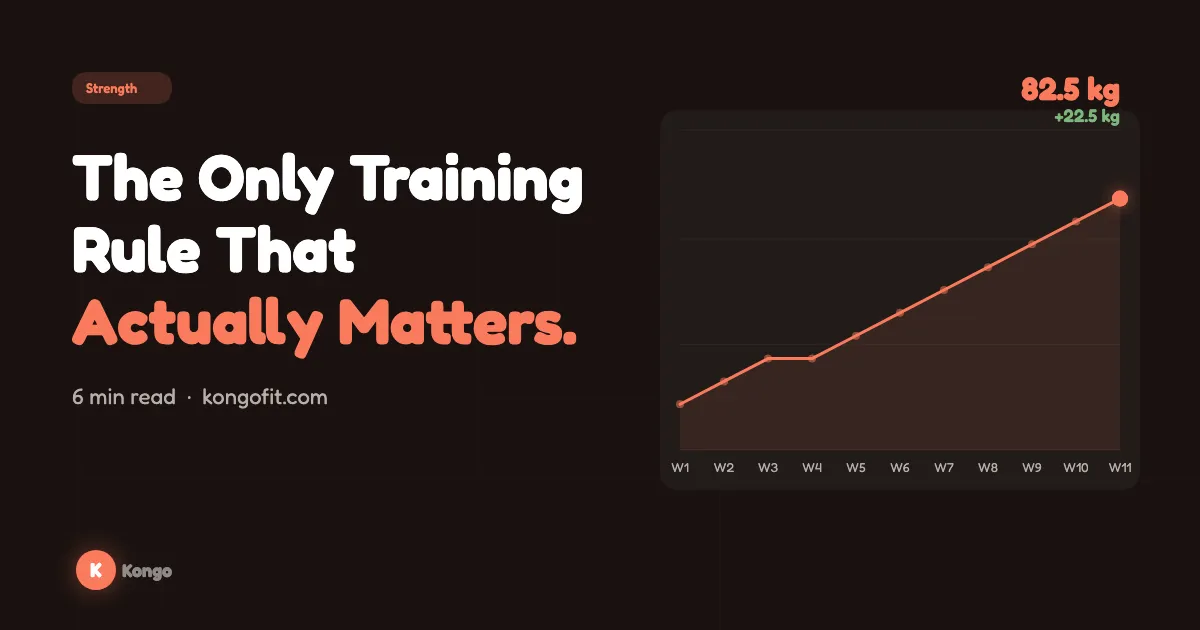
Add weight every session you complete all your reps:
- Squat / Deadlift / Row: +5 kg per session
- Bench / Overhead Press: +2.5 kg per session
This sounds aggressive. It isn’t — it works because of how fast beginners adapt neurologically. In the first few weeks, most of your strength gain comes from your nervous system getting better at using the muscle you already have. Your strength will outrun your muscle growth for a while.
When you miss reps, repeat the weight next session. If you fail at the same weight three times in a row, drop it 10% and rebuild. Don’t ego-load.
Starting weights
Start embarrassingly light. I mean it. Here’s a conservative starting point:
| Exercise | Men | Women |
|---|---|---|
| Squat | 40 kg | 20 kg |
| Bench Press | 30 kg | 15 kg |
| Overhead Press | 20 kg | 10 kg |
| Barbell Row | 30 kg | 15 kg |
| Deadlift | 40 kg | 20 kg |
These will feel easy in week one. Good. You’re building movement patterns, not testing limits. The weights climb faster than you expect.
How long does this last?
For most people, 3–6 months before the simple linear progression stops working — around the point where the ACSM stops calling you a novice. By then you’ll have real strength under you and you’ll be ready for something more varied.
Don’t switch programs early because you’re bored. Program-hopping is an easy way to stall. This routine works precisely because it’s simple — the progress comes from the weight going up, not from the exercises being interesting.
Show up three times a week. Add weight when you can. Track what you do.
That’s the whole thing.
Sources
- American College of Sports Medicine, “American College of Sports Medicine position stand. Progression models in resistance training for healthy adults,” Medicine & Science in Sports & Exercise (2009). link
- Moritani T, deVries HA, “Neural factors versus hypertrophy in the time course of muscle strength gain,” American Journal of Physical Medicine (1979). link
Log it, and Kongo does the remembering
Kongo is a gym tracker for iPhone and Apple Watch. It loads last session's weights, tells you when to add load, and keeps your streak honest. It's launching soon.