You’re at the gym, mid-set, and you’ve hit a wall. The bar feels heavy, your legs don’t want to cooperate, and you’ve been eating “clean” all week — meaning almost no carbs. You figure it must be sleep, or stress, or just a bad day.
It’s not. It’s probably your diet. And here’s the part that’ll annoy you: carbs could’ve prevented the whole thing.
The myth
Carbohydrates make you fat. Cut them out and you’ll lose weight faster, perform better, and feel sharper. Low-carb is the smart move. Keto is even smarter.
This idea has been floating around gyms and diet culture for decades. At this point it’s practically conventional wisdom — which makes it especially frustrating that it’s mostly wrong.
Why it sticks
The logic feels airtight on the surface. Carbs spike insulin. Insulin promotes fat storage. Therefore, fewer carbs means less fat storage. Case closed.
Except it’s not that simple. Insulin also drives nutrients into muscle tissue. The fat-storage effect of insulin is heavily context-dependent — it matters whether you’re in a calorie surplus, not whether you ate a bowl of oats. When researchers pooled 32 tightly controlled feeding studies where calories were matched, swapping carbs for fat didn’t increase fat loss. The lower-fat diets actually came out slightly ahead. And when you’re training hard, carbohydrates are doing something entirely different: they’re fueling your muscles at the cellular level in a way that fat just can’t replicate fast enough (ISSN position stand, 2024).
The low-carb narrative also got a huge boost from early-2000s diet books that made it sound like carbs were uniquely fattening. But the mechanism they described was oversimplified, and the actual weight-loss evidence has never backed it up at scale.
What the research actually shows
Start with weight loss, since that’s usually the main reason people go low-carb. In Stanford’s DIETFITS trial, published in JAMA in 2018, 609 adults spent 12 months on either a healthy low-fat (so, higher-carb) diet or a healthy low-carb one. They lost nearly identical amounts: 5.3 kg vs 6.0 kg. That 0.7 kg difference wasn’t statistically significant. When food quality is equal, carb content doesn’t meaningfully change how much weight you lose.
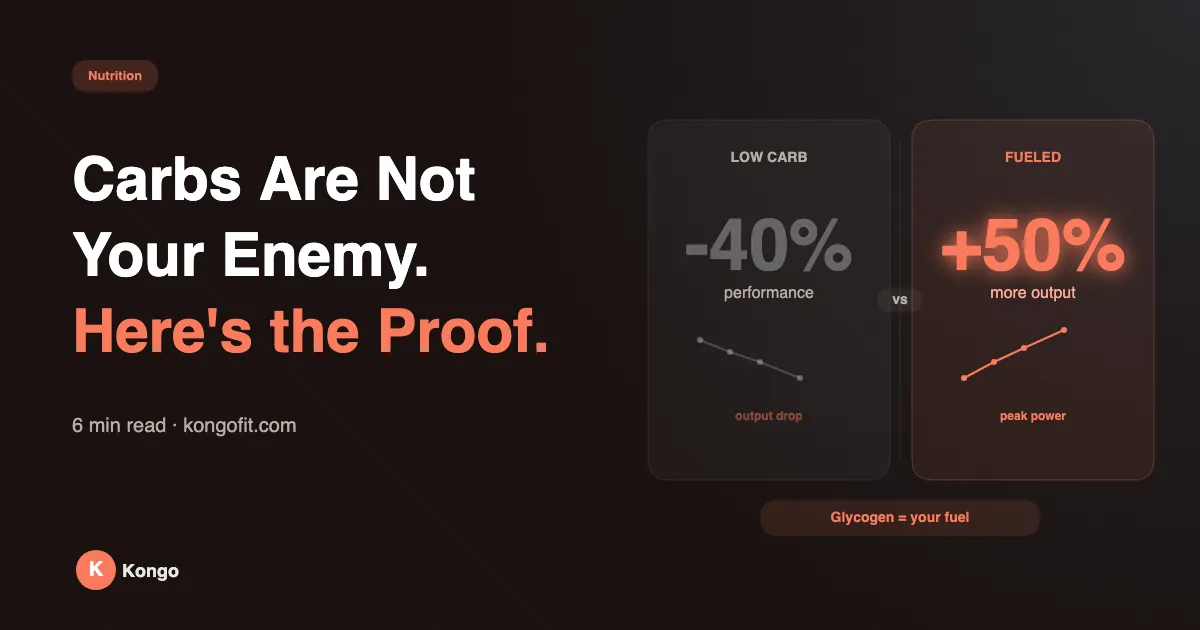
Now look at performance, where the story gets even more lopsided. In a 2019 study in the Journal of Applied Physiology, eight men did hard cycling intervals at 80% of their peak power, starting with muscle glycogen that was already low. Below about 300 mmol/kg dry weight, every further 100 mmol/kg drop cut how long they could keep going by 20–50%. That’s not a minor dip. And “fat adaptation” doesn’t make up for it during high-intensity work (ISSN position stand, 2024).
And the evidence on ketogenic diets for athletes? In its 2024 position stand, the International Society of Sports Nutrition went through 16 controlled trials. One showed a performance improvement. Eight showed worse performance. Seven found no difference. Their conclusion: very low-carb diets tend to hurt performance in elite athletes, and either do nothing or hurt it in recreational ones. At best, neutral.
There’s one more finding worth knowing about. Researchers have tested whether simply rinsing your mouth with a carbohydrate solution — without swallowing any of it — affects exercise performance. A 2025 meta-analysis pooling 33 studies in people who’d already eaten found a small but significant boost, mostly in aerobic exercise. It did little for strength and power, and the authors rate the certainty of the evidence as low. The likely explanation: carbs activate receptors in your mouth linked to brain regions involved in motor control and motivation, before anything is digested. That’s how deeply wired your body is to run on carbohydrates.
What to do instead
You don’t need to eat pasta by the kilo. But you do need to stop treating carbohydrates like a threat.
Match carbs to your training. On days you’re lifting hard, you need carbohydrates — before and after. On rest days, you naturally need less. This is called carb cycling informally, and it’s just common sense applied to fueling.
Focus on quality, not elimination. Whole grains, rice, oats, fruit, potatoes — these are not the problem. Ultra-processed foods are a better suspect. In a 2019 NIH study, people ate about 500 more calories a day on an ultra-processed diet than on an unprocessed one — extra carbs and extra fat — and gained weight. The distinction matters.
Use carb loading strategically. Before a competition or a long endurance event, sustaining a high carbohydrate intake of around 8 g/kg/day for 36–48 hours can roughly double your muscle glycogen, according to a 2025 review in Nutrients. That’s a bigger tank, not a top-up.
Stop judging your diet by how low-carb it is. Judge it by how you perform, how you recover, and whether your lifts are going up over time. Those are the metrics that actually tell you something.
To be fair to keto: in the strength-training studies the ISSN reviewed, most found no difference in strength either way. But lifting still leans hard on glycogen. A 16-set leg session can use up a quarter to a third of the glycogen in your quads (ISSN position stand, 2024) — and carbohydrates are how you replenish it.
Sources
- Gardner CD et al., “Effect of Low-Fat vs Low-Carbohydrate Diet on 12-Month Weight Loss in Overweight Adults and the Association With Genotype Pattern or Insulin Secretion: The DIETFITS Randomized Clinical Trial,” JAMA (2018). link
- Hall KD, Guo J, “Obesity Energetics: Body Weight Regulation and the Effects of Diet Composition,” Gastroenterology (2017). link
- Hearris MA et al., “Graded reductions in preexercise muscle glycogen impair exercise capacity but do not augment skeletal muscle cell signaling: implications for CHO periodization,” Journal of Applied Physiology (2019). link
- Leaf A et al., “International society of sports nutrition position stand: ketogenic diets,” Journal of the International Society of Sports Nutrition (2024). link
- Deng H et al., “Fed, not fasted: is carbohydrate mouth rinsing still ergogenic? A three-level meta-analysis,” Journal of the International Society of Sports Nutrition (2025). link
- Hall KD et al., “Ultra-Processed Diets Cause Excess Calorie Intake and Weight Gain: An Inpatient Randomized Controlled Trial of Ad Libitum Food Intake,” Cell Metabolism (2019). link
- Cao W et al., “A Review of Carbohydrate Supplementation Approaches and Strategies for Optimizing Performance in Elite Long-Distance Endurance,” Nutrients (2025). link

Log it, and Kongo does the remembering
Kongo is a gym tracker for iPhone and Apple Watch. It loads last session's weights, tells you when to add load, and keeps your streak honest. It's launching soon.