On this page
The fitness industry sells a lot of things. Protein powder. Pre-workout. Fancy barbells. Smart scales.
The most underrated performance enhancer costs nothing: having someone who knows whether you showed up.
Why social accountability actually works
Psychology has a name for part of this: the Hawthorne effect — people change their behavior when they know they’re being observed. The evidence on how big that effect is turns out to be patchy (a 2014 systematic review found it exists but couldn’t pin down its size). In fitness, though, it plays out in a straightforward way: when someone else can see your training, you tend to train more consistently.
A 2012 study in Annals of Behavioral Medicine put 58 women on exercise bikes, either alone or with a partner on screen. The ones riding with a partner kept going about twice as long — roughly 20 to 22 minutes versus 11 alone. It worked best when the team’s time depended on whoever quit first, so stopping meant letting someone down.
You probably already know this intuitively. You’ve canceled on yourself plenty of times. You’ve almost never canceled on someone waiting for you at the gym.
It doesn’t require a workout partner
You don’t need someone to physically be next to you every session. In that bike study, the partner wasn’t even in the room. What you need is visibility — the sense that someone can see what you’re doing (or not doing).
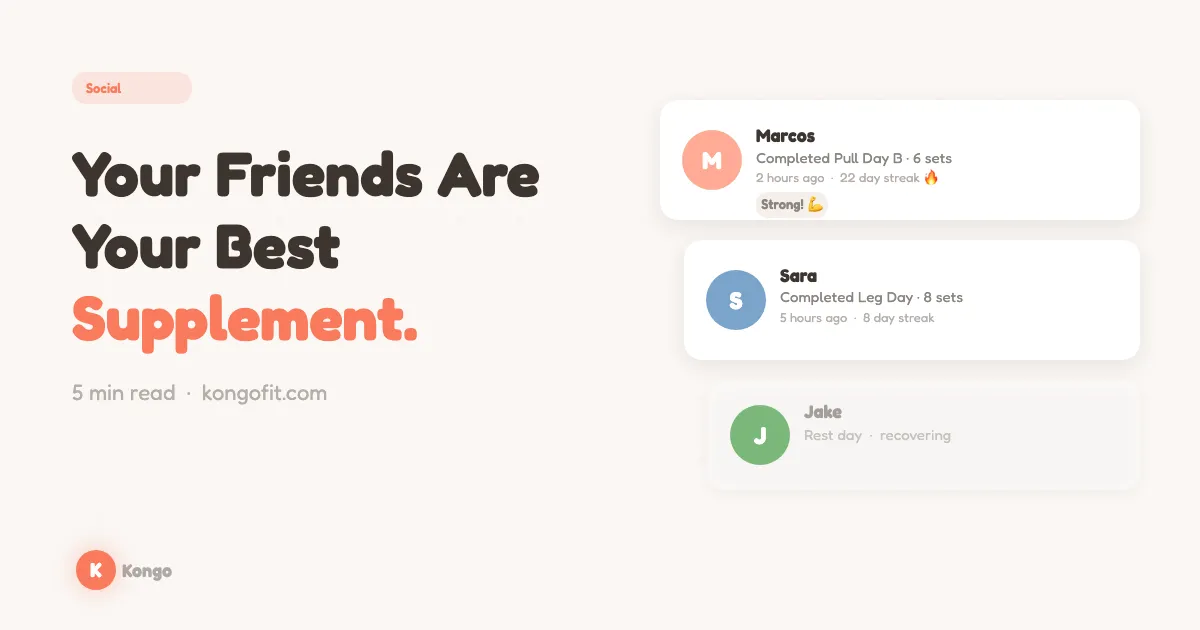
This is why even passive social accountability works. Logging a session that shows up in a friend’s feed. Having someone notice your streak. Getting a “nice work” on a PR you just hit. These aren’t deep meaningful interactions — but they change behavior.
The opposite works too. When you haven’t logged anything in four days, there’s a low-grade awareness that someone might notice. That matters.
Competition makes it better
The right kind of competition — friendly, visible, ongoing — is a strong training motivator. In a 2016 randomized trial with 790 university students, the groups who could see how they stacked up against others went to about 90% more exercise classes than the groups who couldn’t. Comparison beat plain encouragement.
Not the kind where you compare your bench press to someone who’s been lifting for eight years. The kind where you and a friend are both tracking streaks and neither of you wants to be the first one to break it. Or where you can see that your friend just hit a new squat PR and you’ve been meaning to test yours.
This is low-stakes and sustainable. It doesn’t require ego. It just requires both of you to be logging.
How to use this
-
Get your friends on the same app. Accountability requires visibility into the same system. Comparing notes verbally every few days is easy to let slide.
-
Share your streak, not just your goals. Goals are vague and private. A streak is concrete and trackable. When someone can see your current streak, they’re rooting for it.
-
React to their sessions. It takes three seconds, and it tells them someone noticed. A rough Wednesday workout feels less pointless when somebody saw it.
-
Compete on consistency, not performance. “Who can keep their streak longer” is a much healthier competition than “who lifted more.” It rewards showing up, which is the actual skill you’re building.
The best training environment you can build isn’t the perfect gym or the perfect program. It’s a small group of people who can all see each other’s work.
Sources
- McCambridge J, Witton J, Elbourne DR, “Systematic review of the Hawthorne effect: new concepts are needed to study research participation effects,” Journal of Clinical Epidemiology (2014). link
- Irwin BC et al., “Aerobic exercise is promoted when individual performance affects the group: a test of the Kohler motivation gain effect,” Annals of Behavioral Medicine (2012). link
- Zhang J et al., “Support or competition? How online social networks increase physical activity: A randomized controlled trial,” Preventive Medicine Reports (2016). link
Log it, and Kongo does the remembering
Kongo is a gym tracker for iPhone and Apple Watch. It loads last session's weights, tells you when to add load, and keeps your streak honest. It's launching soon.